Training Tip: Draft Mare Is Not Flexing Well
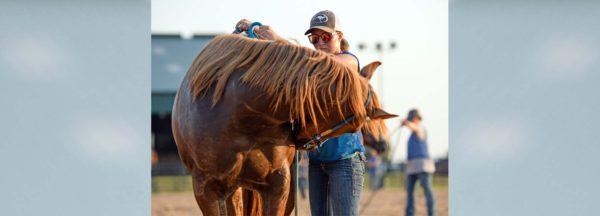
Question: I have a 6-year-old draft mare that was broke by being used to pack and never learned the basics. I have been working with her, but she constantly fights me on flexing and getting soft. Do you have any small pointers that may help me loosen her up and get her to respond better to me? – caseywolf690
Clinton’s Answer: I would concentrate on getting her flexing her head and neck really well on the ground before trying to do the same thing under saddle. We teach our horses how to flex to the halter and lead rope in the Fundamentals Series in four stages—Stage One: Steady Pressure, Stage Two: Bumping on the Halter, Stage Three: Poke and Flex, and Stage Four: Flexing From the Opposite Side.
When we teach a horse an exercise, we start with the concept lesson or teaching stage, where we’re very patient and help the horse understand what we’re looking for. For example, when we first teach the horse to flex, we pick up on the lead rope, wait for him to find the answer, and then release. Once the horse understands the concept and knows what he’s supposed to do, then it becomes the “do it now” stage, where we give the horse a chance to respond correctly and if he doesn’t put a lot of effort into it, isn’t paying attention, or doesn’t try, we increase the pressure until he gives the right answer.
At this stage, we focus on making the right thing easy and the wrong thing difficult. With consistency and repetition, the horse learns to respond immediately with the right answer as soon as asked with the lightest amount of pressure.
Stage Two: Bumping on the Halter is the “do it now” stage of flexing the head and neck. It’ll work on getting 80 percent of horses flexing well. However, for older, stiffer horses, you’ll need to use Stage Three: Poke and Flex to get the horse light and responsive to the halter.
In Stage Three, you’ll use driving pressure on the horse’s ribcage to teach him to bend. Some horses are especially dull to the halter pressure, where you could bump on them all day long and they’ll just continue to lean against it. So when you move the driving pressure to their belly, they aren’t able to lean against it as much.
Keep in mind that horses don’t have hard mouths, they have hard, stiff bodies. All the resistance you feel in your horse’s head or mouth is coming from her body. If you get the body soft and supple, the head and mouth will feel light. That’s why in this exercise, you’ll use driving pressure on the horse’s ribcage to teach her to bend. It’s still the same concept as using driving pressure with the halter: Ask with steady pressure, then tell with driving pressure.
It’s also important to realize that each horse is an individual. Just like us, they all have their own sets of strengths and weaknesses and their own personalities. Our job as trainers is to bring out the best in each horse. Even though your horse might be a C- at flexing compared to Diez, that C-, for your mare, may be her A+.
Draft horses are bred to pull heavy loads, they aren’t bred to be overly soft and supple and quick on their feet. That doesn’t mean that you can’t improve your mare, but you have to be realistic about what she can do. If a horse reaches the best of their ability and you keep increasing the pressure and asking for more, they’ll shut down on you mentally and physically and go from a C- to an F.
Have a horsemanship question or looking for more training tips? Check out the No Worries Club.
