Training Tip: Understand Why Your Horse is Fearful of Gullies
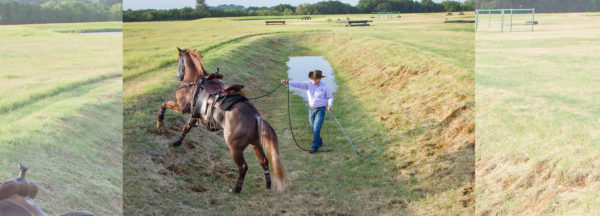
One of the main reasons horses find gullies so frightening is because of their vision. Horses have monocular vision, which means that they use each eye separately. That’s why your horse may spook at something that he’s already walked past and reacted to once: He’s seeing it for the first time with his other eye. For a prey animal such as the horse, monocular vision has its advantages. With his eyes placed on the side of his head, the horse can see almost all the way around his body. He has two small blind spots, one right in front of his nose and another directly behind his tail. That’s why he notices objects or movements behind him that you can’t even see without turning around. Being able to see all around his body helps the horse spot predators lurking in the wild.
The downside to monocular vision is that it gives the horse poor depth perception. It is hard for a horse to tell how far away an object is from him or how deep an object is, particularly when it is close to him. That’s why horses will often bob their heads up and down when they’re looking at objects that are up close and down low to them – they’re trying to get a grasp of them.
Many horses will stop at the edge of a gully and tilt their heads to the side and snort at it. That’s the horse trying to see the object from a better angle. Because of his vision, it’s hard for him to tell whether the gully is 3 feet deep or 100 feet deep.
Add to that the fact horses have a tendency to feel claustrophobic when they’re in a tight, narrow space such as a gully, and it’s no wonder that getting a horse to confidently cross or walk through a gully is difficult.
